Repair or Replace a Water Heater? Age Guide | Madison
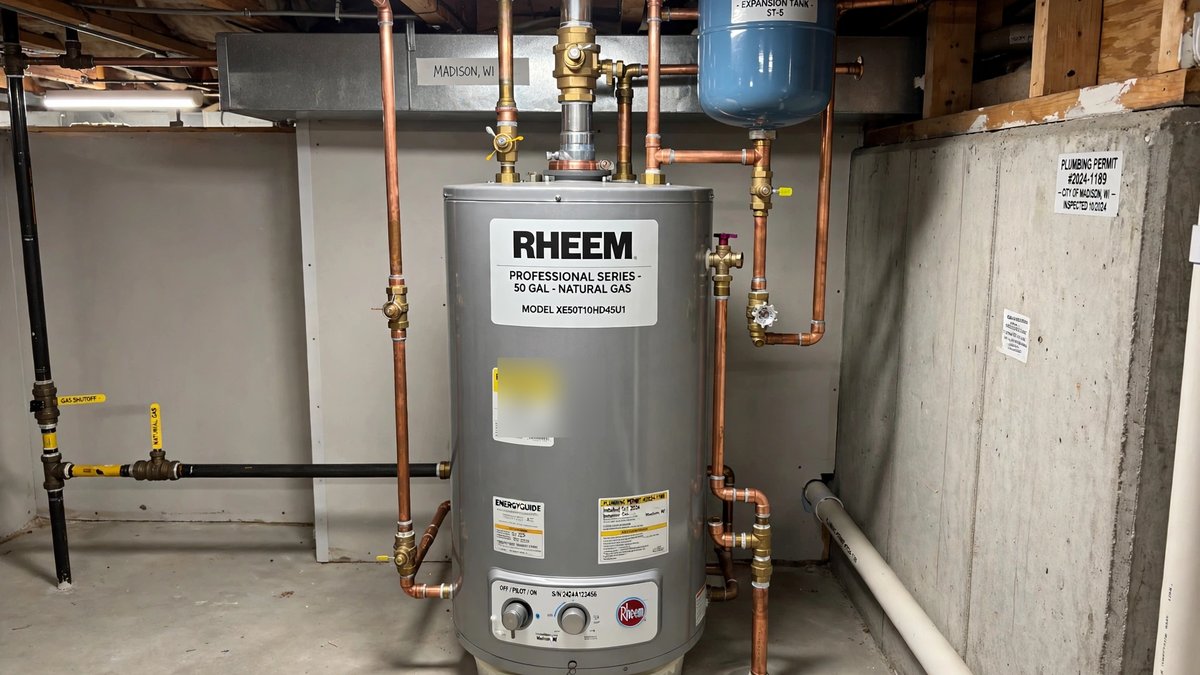
How old is your water heater?
Age is the first input. The data label on the tank carries a serial number, and most manufacturers encode the month and year of manufacture in the first digits or letters. The code differs by brand, so look up the decoding method on the manufacturer’s website or ask the plumber. Typical lifespans:
| Type | Typical lifespan |
|---|---|
| Gas tank | 8 to 12 years |
| Electric tank | 10 to 15 years |
| Heat pump | 10 to 15 years |
| Tankless | 15 to 20 years with maintenance |
These are general benchmarks. Hard water, deferred maintenance, and heavy use shorten them, and a heater with regular flushing and anode rod service can last longer.
A simple decision test
Start with age and condition, not a single number. If the heater is young, the tank is sound, and only one part has failed, repair is generally the better choice. If the heater is past roughly half of its expected life, has already needed several repairs, or shows rust or leaks, replacement usually makes sense. As a rough guide, if a repair would cost about half or more of a replacement, replacement is usually the better choice — the 50% rule.
Two examples
Take a gas tank heater that is 11 years old. A plumber finds a single failed thermocouple, and the tank itself is sound, with no rust or leaks. Repairing that one part is reasonable, and you can plan for replacement in the near future. Change one detail: the plumber finds a leaking tank instead. A leak means the tank itself has failed, so repair is not an option and the heater needs replacement.
Signs that point toward replacement
- Water leaking from the tank body rather than a fitting
- Rust-colored hot water that continues after a flush
- Repeated repairs in a short period
- A heater older than its expected lifespan
- A tank that no longer meets your household’s hot water needs
- A part that is no longer made for an old model
For leaks, see leaking water heater repair, which explains how to tell fitting leaks from tank failure.
Efficiency and running the heater
Newer heaters tend to have better insulation and more efficient burners or elements. A heat pump water heater uses far less electricity than a standard electric tank, though it needs space and airflow and cools the room it sits in, which matters in a Wisconsin basement. Tankless heaters avoid standby losses but need descaling in hard water. Energy use varies by household, so ask the plumber what to expect, and check Focus on Energy for current incentives.
Madison conditions that affect the decision
Madison-area groundwater is hard, and scale shortens the life of tank bottoms, elements, and tankless heat exchangers. A heater in a home without a softener often ages faster than the benchmark suggests. Winter inlet water is very cold, so the heater works harder from December through March. A basement installation raises the stakes of a failure, so a heater that is old and showing leak signs is a risk to the floor and walls.
Comparing the next five years
Take a 13-year-old electric tank that has already needed two repairs in a year. The tank is near the end of its expected life, and the same problem keeps coming back. Even if the next repair fixes the immediate fault, the heater is likely to need attention again soon. In that situation, replacement on your own timeline is usually the better choice, because it also lets you pick a heater that fits the home instead of rushing during an emergency.
Do not forget the risk of failure. A tank that fails on its own schedule can flood a basement, and water damage can be far worse than the heater itself. Replacement on your own timeline also lets you choose a heater that fits your home instead of accepting whatever is available during an emergency.
Warranty and documentation
Many tank heaters carry a manufacturer warranty on the tank, often several years, and a shorter warranty on parts. Some warranties cover only the part and not the labor. Before you approve a repair or replacement, ask the plumber to check the model and serial number for coverage and to explain what the labor warranty includes. Keep the invoice and the data label photo in a safe place, because both are useful if a problem comes back.
Choosing the replacement type
If you do replace, you do not have to buy the same kind of heater. Gas homes can stay with a gas tank or move to tankless, though tankless needs adequate gas line capacity and venting. Electric homes can consider a heat pump model if the basement has enough space and airflow. Ask the plumber to size the new heater based on the number of people in the house and the number of fixtures that run at once, not simply to match the tank that is leaving.
Putting it together: a quick decision guide
- Find the age from the serial number.
- Check the tank for leaks, rust, and noise, and note whether the same problem has come back.
- If the tank leaks, or the heater is past its expected life and showing wear, replacement is usually the better choice.
- If the heater is young, the tank is sound, and only one part has failed, repair is usually the better choice.
- If the heater is young and under warranty, ask the plumber to check coverage first.
To start with an expert diagnosis, call (608) 817-2841. Dispatch connects you with an independent plumber, and our page on water heater repair in Madison explains the process. For replacement details, see water heater replacement, and for routine care, the Madison maintenance checklist.
Frequently asked questions
Should I replace a 10-year-old water heater before it fails?
It is a judgment call. If it works well and has been maintained, you can wait, but plan for replacement. If it is leaking or rusting, do not wait.
Can a water heater last 20 years?
Some do, especially with regular flushing and anode rod service, but hard water and neglect shorten life. Treat any heater beyond 15 years as living on borrowed time.
Does replacing the anode rod extend life?
It can. The rod corrodes first so the tank does not. A plumber can check it during a service visit.
Business: Madison Water Heater Pros
Address: 706 Post Rd, Madison, WI 53713, USA
Hours: Mon, Tue, Wed, Thu, Fri, Sat, Sun: 00:00-23:59
Water heater problem? Talk to a local plumber now.
Call (608) 817-2841
Dispatch answers 24/7 — you are connected with an available local professional.